

Chameleon Dyes
Note: I am revising the following information. I had the opportunity to speak with one of the directors of LCR Hallcrest, a company that makes chameleon dyes.
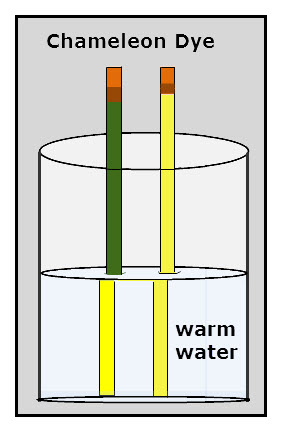
The pencils in the picture are called chameleon pencils. While chameleons change colors in response to different stimuli, such as temperature, emotions, and illness, the dye used on the pencils respond only to temperature changes.
Thermochromic is the term used to describe a color change due to a change in temperature.
While “Chameleon Dyes” is a fun title, the actual name for the dye used on the pencils is called Leuco dye. There are two types of Leuco dyes:
1. Cold Activated Dye: Clear to Color
This dye is clear at room temperature, but has a color change when the temperature decreases. Different dyes have a different color at specific temperatures.
2. Heat Activated Dye: Color To Clear
The Leuco dye used on the indicated pencil is heat activated. This means that at normal room temperature, the dye has a color. But, when heated the dye molecules rearrange and their new position is transparent to visible light.
The pencil on the left is covered with a green mixture made by combining yellow paint and blue Leuco dye. Yellow + Blue —-> Green
To better understand how blue and yellow reflected light make the pencil look green, see Visual Perception.
When heated the blue color from the dye becomes clear and the yellow paint, which is not affected by the heat, is visible. (The pencil painted with yellow paint is a control used to show that heat doesn’t affect the paint’s color.)
Enriched Information About Color Changes Products
Leuco dyes which have the property of changing from a color state to a clear state when a stimulus is applied, and then returning to a colored state when the stimulus is removed are called reversible Leuco dyes. The stimuli for the color change depends on the dye. Stimuli includes heat and light. Those that are heat sensitive are considered thermochromic. Those that are light sensitive are considered photochromic.
Liquid Crystals, like Leuco dyes are thermochromic.

Big Book of Science Experiments
A book of fun informative experiments about astronomy, biology, chemistry, earth science, and physics.
(Paid Link)