Catalyst vs. Enzymes
A catalyst is a chemical that changes the speed of a chemical reaction. Generally a catalysts increases the rate of the reaction.
Organic catalysts found in living organisms are called enzymes. Enzymes are proteins found in both plants and animals.
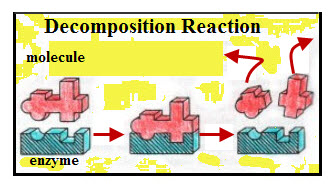
It is believed that enzymes act like a holder into which molecules fit like puzzles pieces. Some enzymes, like the one shown in the diagram, receive a single molecule, and then the enzymes bends and/or twists causing the molecule to break apart. The diagram shows one molecule entering the enzyme and two separate molecules exiting.
Catalase is an enzyme that decomposes molecules of hydrogen peroxide, which is a chemical produced by some chemical reaction in cells.
Catalase like all enzyme is specific for one job. This means that catalase can only decompose one chemical, which is hydrogen peroxide.
Enzymes are used to make meat more tender. Meats are “tough” because of the presence of the tough, insoluble protein collagen. Meat tenderizers contain enzymes that digest (decompose- break apart) collagen molecules.
Synthesis (Combination) Enzymes
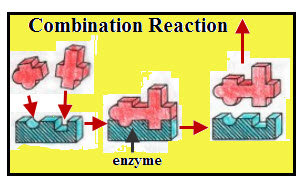
Another type of enzyme receives separate molecules that join and then separate from the enzyme as a single molecule. The diagram is a model of this combination reaction, called a synthesis reaction.
Notice that combination reactions are the reverse of decomposition reactions. For a model of how an enzyme synthesizes a molecule, see CATALYST.
Recycling of enzymes
When the separate or single parts break away from an enzyme, the enzyme is then free to be used again. This entire cycle happens so fast that a single enzyme can make about 1,000 changes per second or even faster.
Since enzymes are used over and over and work so fast, it only takes a small number of enzymes to cause form can thousands of chemical reaction every second. Eventually the enzymes wear out and the cells of the living organism (plant or animal) make new ones.
Synthesis occurs when an enzyme combines several smaller molecules into a large one.
Enzymes cause both desired and undesired changes in food. For example, they are responsible for color, flavor, and texture changes as fruits and vegetables ripen. But, they also cause the foods to continue to ripen and eventually rot.
Summary
Information from Natural and Eco-Safe Products
“All activity of life depends on enzymes:
- plant growth
- seed germination
- the ripening of foods
- ripening of fruits and crops
- The greening of leaves in spring
- the digestion and absorption of food
For more information about enzymes, see Janice VanCleave’s Food and Nutrition for Every Kid.

Food and Nutrition for Every Kid
(Paid Link)