Geometry: Angles

What is Geometry?

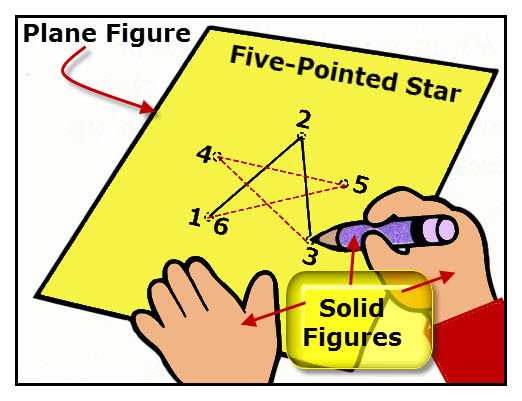
A diagram of a child drawing a five-pointed star on a paper pattern model examples of a plane figure-paper, and solid figures--hands and pencil.

Geometry is all about shapes and figures. The dot-to-dot pattern in the diagram produces a five-pointed star as well as six other geometric shapes—five triangles and one pentagon.

Geometry is the mathematical study of figures and shapes. Let’s find out the difference between figures and shapes, define angles and of course, play and learn how angles form polygons–closed, straight sided figures.

Figures vs. Shapes

A geometric figure is the entire object, while a shape is the outer form of the object.

There are two types of figures: plane figures and solid figures.

2-D, two-dimensional figures, such as the yellow paper in the diagram have length and width. Plane geometry is a study of plane figures–2-D figures.
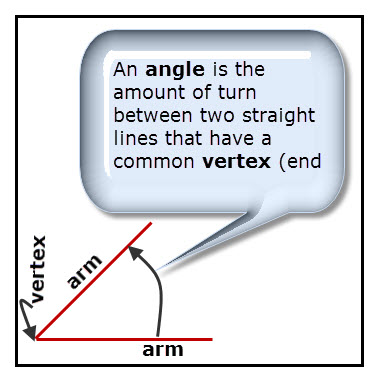
The angle definition is represented by two lines connected at one end, called the vertex. The lines, called arms are separated. Your fingers can be used to model angles. Separate any two adjacent fingers and an angle forms. The more the fingers are separated the greater is the angle between the fingers.

The lines forming the angle in the diagram are called arms. While the arrow between the arms indicates that the upper arm moved away from the lower arm, angles can be formed when either or both angles move away or toward each other.

3-D, three-dimensional figures, such as the pencil and the child’s hands in the diagram have length, width, and height. Solid geometry is a study of solid figures–3-D figures.

Where do angles fit in?

After studying the following information about angles, use the Math is Fun drawing pad
to practice drawing a five-pointed star using the dot-to-dot method. Then draw a pentagon–a closed figure with five straight sides. Add a triangle (three sided polygon) on each of the five sides–what do you think of your star design now?

Names of Different Types of Angles
 

311413: Geometry Fun Activities Science For Every Kid: Geometry


Related Posts

  1. Star Pattern
  2. Teach Hypothesis Using Möbius Strips
  3. Hygroscopic
  4. Plane Figures: Polygons
  5. Center of Gravity vs. Center of Mass
  6. Math and the Bible
  7. Shapes Cut From Homemade Dough
  8. Newton’s First Law of Motion
  9. Science Games and Crafts
  10. Wood Absorbs Water