

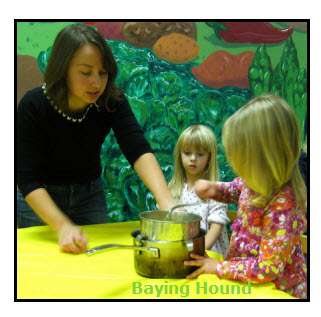
Home study provides endless ways for you and your children to play and find out about science.
You have a fantastic science laboratory in your kitchen with a bounty of chemicals and laboratory tools.
I am not minimizing the importance of learning to use science equipment. My thought is that by mastering measuring skills using familiar measuring items helps kids to be more successful when introduced to scientific measuring instruments. I am so accident prone that when possible I use plastic measuring tools.
Most educators OVER TEACH. This means they ask questions and give the answers before kids have time to think. In science, answers to questions are best learned by discovery. Your best answer to most questions is: “I wonder… Why does that happen?” “Let’s Find Out!” I said this so much that my grandchildren might start to ask a question but would stop and say–“I KNOW–YOU WONDER ABOUT THIS. SO LET’S FIND OUT!” They thought they were being cute but I received this as my reward.
CAUTION: Kids that are use to being “spoon fed” information may balk at having to work for the answers, even if it is fun work. But, I have found that once introduced to the the inquiry method of science, kids will find the “spoon fed” method boring.
Things to Remember:
1. No matter your science background, be the facilitator or even better, partner with your child as you play and find out about science TOGETHER.
2. While every child will not choose a science career, every child will benefit from mastering science skills.
The book is designed to help young students catch the “science bug”
Teaching the Fun of Science to Young Learners
The book’s 75 lessons and reproducible activities touch on all areas of science and provide the key to a world of science magic and mystery. While kids will have fun doing the activities and learning to love science, they are also being encouraged to develop other skills, including reading, writing, math, and art.
(Paid Link)