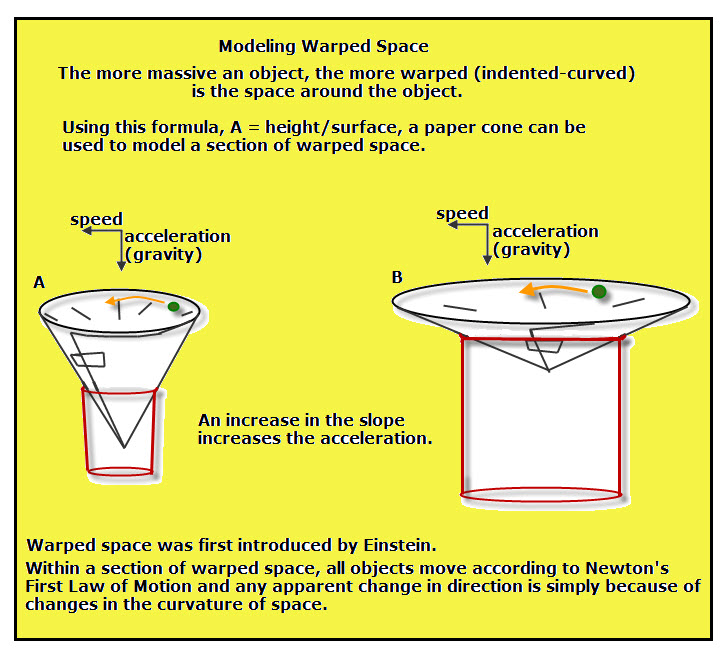
Know that this is a model of the warping of space by two objects with different masses. The paper cones in the diagram below are made from white poster board. Using two sheets of poster board, I cut the two identical and the largest possible circles. The dashed line in the diagram to the right […]
Barycenter of Bodies of Unequal Mass
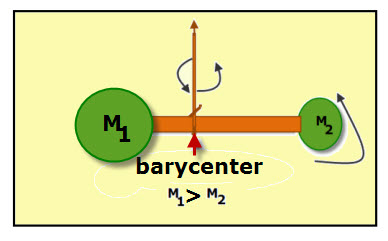
The Animation represents two celestial bodies of unequal masses orbiting around a common barycenter. The barycenter is the center of mass of the two bodies. If the bodies had a connecting rod between them, the center of mass would be where the bodies could be balanced. Animation The animation represents two celestial bodies of different […]
Barycenter of the Earth-Moon System
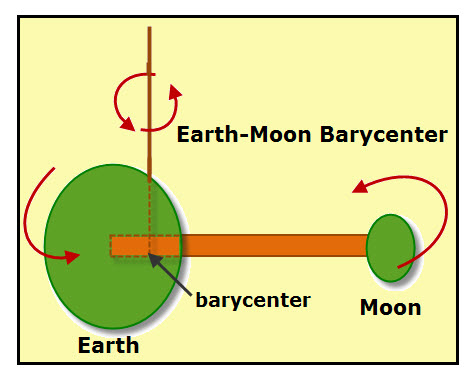
Barycenter of the Earth-Moon System
Moon Landing
Neil Armstrong and Buzz Aldrin hold the title of being the first to walk on the Moon. There were three crewmen, the third being Michael Collins who orbited in the Command Module while Armstrong and Aldrin were on the Moon’s surface. For details and photos, see Apollo 11 Mission.
Lunar Cycle Challenge
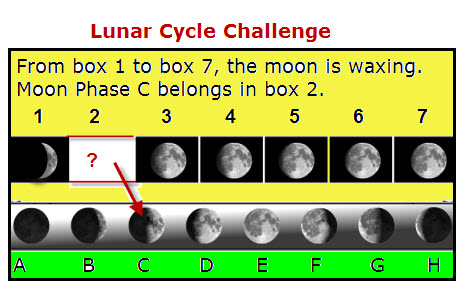
From Earth, the Moon looks like a round disk in the sky. At times this disk appears to have part of it cut away or is overlapped by something that is dark. The edge or line where the lighted part of the moon disk ends is called the terminator. In the Northern Hemisphere, the terminator […]
Equinox Model
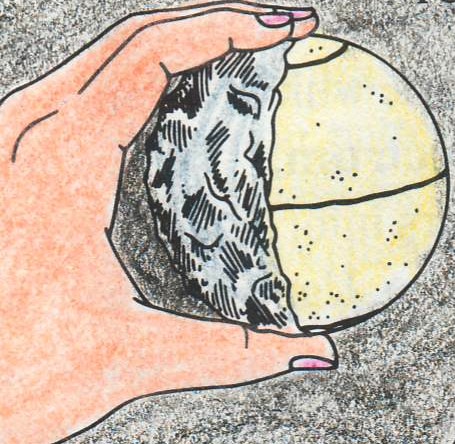
To model the light and dark areas of Earth during equinox, use aluminum foil and a 2-inch (5-cm) Styrofoam ball. With a blackmarker, make two dots opposite each other on the ball. Draw small circles around each dot to represent the Arctic and Antarctic Circles. Again use the marker to draw a circle around the […]
Astronomy Science Project
Overview for an Astronomy Project Your entire project is about a science question you choose to solve. Thus, the project question is very important. The following gives you a “bird’s eye view” of how to select an astronomy question and how to evaluate the question. I. RESEARCH A. “Tinkering” Research or ” I Don’t Know […]
Black Hole Facts
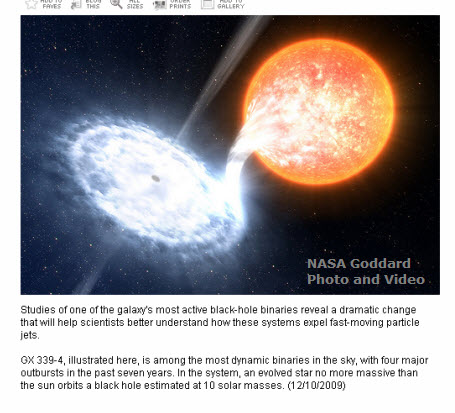
A black hole starts out as a star, which is very large. Stars give off light because of the nuclear reaction in its core. This reaction produces massive amount of energy resulting in extreme temperatures. The motion of particles increases with an increase in temperature. The kinetic energy of these particles is in an outward […]
Scale Model:Solar System
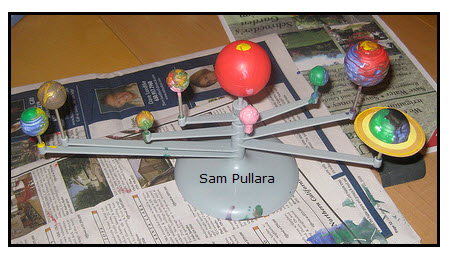
Solar System Scale Model A. Planetary Distances: A scale of 1 cm:5×10⁶ km (1 cm : 5 million km) can be used to make a model for for planetary distances. To calculate the model distance of planets to the Sun divide the actual distance of the planet by 5 million km. The answer will be […]
Moonshine
Q: Why is the Moon brighter at night than during the day? A: The Moon is more visible at night because the sky is darker. During the day there are stars in the sky but they are not visible because the Sun’s light makes the sky so bright. Notice how bright the stars look at […]