This page is a continuation of directions for making slime as a science fair project. Note: This information contains ideas and information. It is not intended to be used directly for your project. Instead, use the information as a guide for designing and developing your own science fair project.
Step 6 : Example Experiment
The purpose of your project experiment is to test your hypothesis.
Example Hypothesis
Viscosity measures how easy something flows. Glues with a high viscosity will produce produce thick, slow flowing slime.
You need an experimental investigation in which you test the viscosity of slime that has been made with glues of different viscosities. The following experiment is more of a descriptive investiagion–which means the procedure is being given so that you have a guide for designing your own experimental procedure. Yes, your experiment can be very similar to this descriptive investigation, but there has to be an independent variable that you chose. The independent variable that I am using for this example is the viscosity of glue used to make slime.
Science Fair Project Experiments should have measurable results.
Making Slime
Procedure
1. In a small jar, make a Borax Solution. Do this by mixing 1 teaspoon of borax in 1 cup of tap water. Stir well.
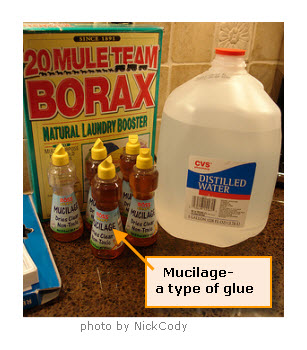
You are not changing how this solution is being prepared, but I do suggest that you make a larger amount for all your different tests. For 1 quart of water, add 4 teaspoons of borax (20 Mule Team Borax is a water softener found with detergents.) Since tap water is different in different cities, I suggest that you use distilled water to make all your solutions.
2. In a small jar, make a Glue Solution by mixing one 1/2 cup (4-oz bottle of Elmer’s White School Glue) with 1/2 cup of tap water. Stir Well.
You need to rewrite this procedure step adding a list of the different types of glues that your will be preparing solutions for. These can be different brands of white school glue as well as glue-gels and the mucilage shown in the photo.
3. At the same time, pour the glue solution and the borax solution into a bowl (at least a 2 quart size).
Instead adding together 1 cup of glue solution and 1 cup of borax solution, I suggest that you use the same ratio but use smaller amounts. You want to make at least four samples of slime from each glue solution. So, use 1/4 cup of glue solution + 1/4 cup of borax solution.
4. If you are not allergic to borax, stir the mixture with your hands, and then dip out the slime. Knead the slime with your hands until it is dry.
5. You need to design a way in which the viscosity of each slime sample will be measured. For example, place slime samples at the top of an inclined surface and measure the distance each sample flows in a time that you decide on. For example, how far do they flow in 4 minutes.
Remember: Science Fair Project Experiments should have measurable results. For this experiment you are measuring distance and time. The time is constant–4 minutes or what ever amount you decide on.
It is important that each slime sample is tested under the same conditions–room temperature, incline, etc…..These are all the controlled variables previously discussed.