

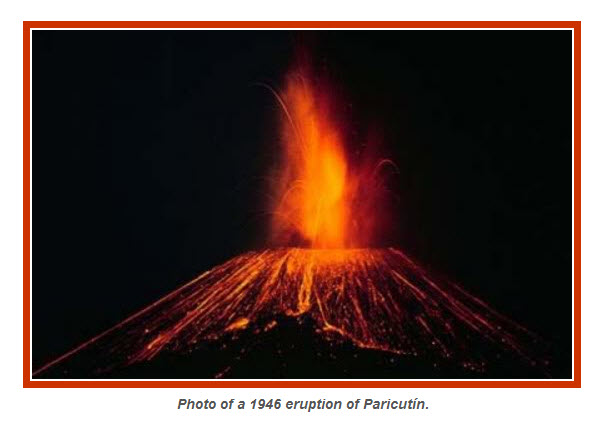
A volcano is the mountain or hill formed by the accumulation of materials erupted through one or more openings in the Earth’s surface. The pipe-like openings that connect the volcano’s crater (depression at the top) to the magma chamber (pool of molten rock deep within the Earth) are called volcanic vents.
Volcanoes form because heat and pressure within Earth cause rock to melt. This molten rock, called magma, is less dense than the solid rock around it, so it is slowly forced toward the surface of Earth. Magma that reaches Earth’s surface through vents is called lava. A volcanic eruption is when lava, ash, debris, and/or gas is thrown out of a volcano. Some eruptions are very explosive while others are relatively quiet outpouring of bubbling lava or even gas.
Some volcanoes on Earth are active (erupted within the last century), but most of them are dormant (inactive). Dormant volcanoes have not erupted in hundreds of years, but they could. Volcanoes that have not erupted in thousands of years are considered extinct and most likely will never again become active. There are more than 5,000 active underwater volcanoes and more than 800 active above-sea volcanoes in existence around the world.
Different types of eruptions produce different kinds of volcanoes. Following are three different types of volcanoes, for more information about these volcanoes and the different types of lava produced, see Exploring the Environment: Volcanoes
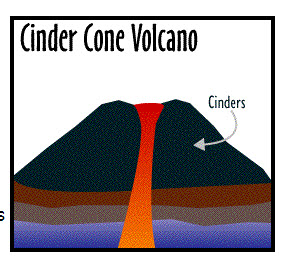
1. Cinder Cone Volcanoes
Explosive eruptions throw lava high into the air. The lava cools and hardens into different volcanic material called tephra (lava blasted into the air by a violent volcanic eruption that solidifies as it falls to the ground). Tephra comes in different sizes, including ash, cinders, and large rocks called volcanic bombs. A cinder cone volcano is formed by an explosive eruption in which tephra piles up into a steep-sided loosely packed cone. As the tephra fall back down around the vent, the heavier materials fall near the vent and the lighter weight materials are thrown farther away. This type of volcano usually has a rounded top with a small bowl-shaped crater (hollowed-out area at the top of a volcano). The upper parts of the volcano are steep with a more gently sloping base. There are many cinder cone volcanoes in the western United States, such as Sunset Crater in Arizona. These volcanoes are also found in many other parts of Earth, including the island of Java, in Indonesia.
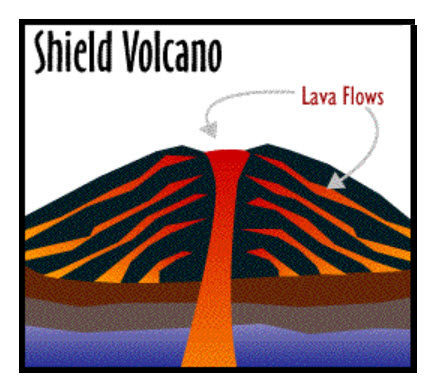
2. Shield Volcanoes
A shield volcano (a volcano composed of layers of solidified lava, a wide base, and a large, bowl-shaped opening at the top) is generally less steep and shorter than other types of volcanoes. It is made by repeated eruptions producing lava flows. The lava forming this volcano is relatively thin and flows away from the vent. As the lava cools, it becomes thicker, flows more slowly and finally becomes solid. Mauna Loa in Hawaii is one of the largest shield volcanoes.
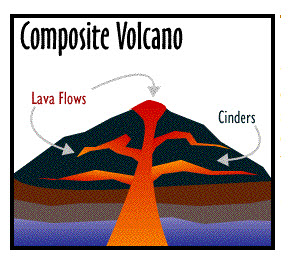
3. Composite Volcano
A composite volcano (cone-shaped volcano formed by alternating layers of solidified lava and rock particles) is a combination of a cinder cone and shield volcano that results from alternating eruptions of volcanic debris and lava. This type of volcano is likely to be the tallest and steepest volcano. Mount Rainier, in the state of Washington, is an example of a composite volcano.

Big Book of Science Experiments
A book of fun informative experiments about astronomy, biology, chemistry, earth science, and physics.