

Identify the Motions that Represent Newton’s Laws of Motion
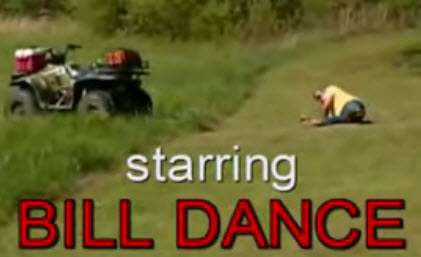
Bill Dance's Fishing Bloopers Demonstrate Newton's Three Laws of Motion.
The video below will make you laugh. It is a series bloopers made by Bill Dance a famous fisherman. It is definitely a video about motion and every one of Newton’s Three Laws of Motion are repeatedly represented. Kids can watch the video looking for examples of each law. Following is a description of the three laws:
First Law of Motion (Inertia): Basically inertia is the characteristic of motion describing how a moving object continue to move unless acted on by some force. For example: When riding in a car and the car suddenly stops, you continue to move forward. That is why seat belts are worn.
Second Law of Motion (force -acceleration): If a constant force acts on an object, that object will accelerate. For example: If you drop a ball, the force of gravity causes the ball to accelerate downward at a rate of about 10 m/sec 2. This means that the ball’s speed increases 10 m/sec for every second that it falls. In other words, it gets faster the longer the time it takes for the ball to fall.
Third Law of Motion (action-reaction): For every action there is an equal but opposite reaction. The following examples identify action-reaction pairs of forces.
Action Motion: Your hand hits a desk with a force, F1.
Reaction Motion: The desk pushes back on your hand with the same force, F1.
Results: There is some microscopic movement of the molecules in the desk, but nothing you can see. Your hand might move away from the desk, but mainly you feel the reaction force of the desk against your hand. The harder you hit the desk, the harder the desk strikes your hand. If the desk did not push back, your hand would just keep moving through the desk until something stopped it–your muscles could stop its motion.
Action Motion: Using a baseball bat, you strike a baseball with a force, F2.
Reaction Motion: The baseball pushes back against the baseball bat with the same force, F2.
Results: This takes a bit of thinking. First, if the ball is pitched to the batter, and the batter swings and connects with the ball, two pairs of action-reaction forces are involved.
1. The pitched ball hits the bat with a force, F3.
The bat reacts by hitting the ball with the same force, F3.
This happens if the bat is stationary, such as if the batter bunts the ball.
2. The batter swings the bat hitting the incoming baseball with a force, F2.
The ball reacts by hitting the bat with the same force, F2.
So, what happens? The ball being lighter than the bat, is struck with a total force of F2 + F3. The direction of the combined forces sends the ball flying away from the batter. Hopefully far enough for a homerun.
The bat being heavier than the ball and also being held by the batter, recoils, meaning it moves back toward the hindcatcher. Or if the combined force of F2 + F3 But, since the batter swung the bat forward, toward the pitcher, the recoil doesn’t push the bat so that it hits the hind-catcher. If the bat breaks, peaces of it go flying toward the pitcher and other players nearby.

Physics investigations for middle school and/or high school students. Ideas for developing investigations into a science fair project.