

What is air pressure?
Pressure is a measure of a force on a specific area of surface.
Air pressure is the force of air on an area of surface.This is a good definition, but it doesn’t tell you what’s happening. So here is the nitty gritty about how I understand the cause of air pressure:
Air is made up of individual molecules of different gases.
Air pressure is the result of air molecules colliding with a surface.
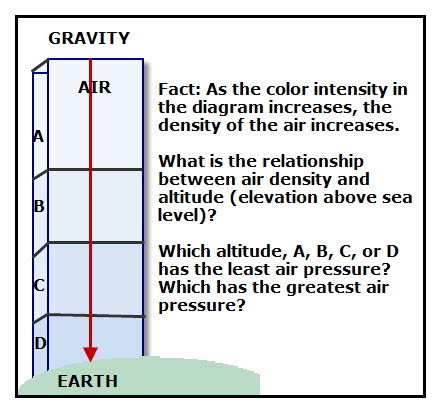
As the density of air increases, the number of molecules colliding with a surface increases resulting in an increase of air pressure on the surface. The reverse is also true, as the density of air decreases, the number of molecules decrease resulting in fewer collisions with a surface thus less pressure on the surface. This relationship can be expressed as:
An increase in the density of air results in an increase of molecues in an area, and thus an increase in air pressure.
Air Pressure Experiments:
Use a plastic bottle with three holes as shown in the diagram. Note, the top two holes are covered with tape. For more information about preparing the bottle, see Pressure.
1. When about half of the water has streamed out of the bottle, seal the bottle with a lid. Results: When 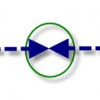 the bottle is closed, the water continues to stream out. This occurs for a while, but then the water stops streaming out of the bottle. This occurs because the combined pressure of the air inside the bottle and the weight of the water (water pressure) equals the air pressure outside the hole trying to force its way into the bottle through the open hole.
This is represented by the diagram with two identical blue arrows. The arrow represent equal forces inside and outside the bottle.
Facts:
If the bottle is open and there is one open hole, the affect of the height of the water above the hole on the water stream is: The greater the height, the farther the water sprays. As the water level decreases, the air pressure inside the bottle remains the same, but the weight of the water decreases. The results could be represented with arrow drawings starting with the diagram. The following series of diagrams would show the blue arrow progressively getting smaller. When the water level is below the hole, the air would start entering the bottle, represented by the arrow diagrams, starting with the one shown (A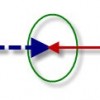 large blue arrow on the right and small red arrow on the left.)