

 Question:
What is the atmosphere?
Answer:
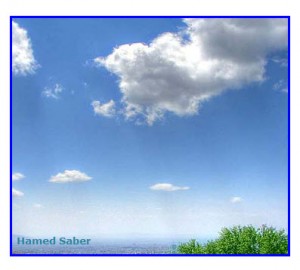
Some planets, such as Earth and Venus have a layer of gas surrounding the planet, which is called the atmosphere. Earth’s atmosphere reaches out from Earth’s surface for over 350 miles (560 kilometers).
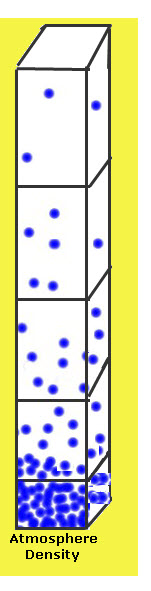 The atmosphere diagram (left) represents the density of air in Earth’s atmosphere. The blue dots represent molecules of gases that make up air. The greater the density of air the more dots and the closer the dots are to one another on the diagram. The bottom layer represents the atmosphere touching Earth’s surface at sea level. As the altitude (height above sea level) increases, the density of air decreases.
Question:
What is the atmosphere?
Answer:
Some planets, such as Earth and Venus have a layer of gas surrounding the planet, which is called the <strong>atmosphere. </strong> Earth’s atmosphere reaches out from Earth’s surface for over 350 miles (560 kilometers).
The blue dots represent molecules of gases that make up air. The greater the density of air the more dots and the closer the dots are to one another on the diagram. The bottom layer represents the atmosphere touching Earth’s surface at sea level. As the <strong>altitude</strong> (height above sea level) increases, the density of air decreases.
Question:
Why is air density greatest near Earth’s surface?
Answer:
The gas molecules that make up air are pulled toward Earth’s surface by a force called <strong>gravity.</strong>
The magazine at the bottom of the stack is being pushed down by the weight of the stack of magazines above it. The same thing is true for the bottom layer of of the atmosphere.
From Top to bottom, the magazine pages are more and more pressed together. This is because from top to bottom, the weight of the stack increases. The same thing is true for the air in the atmosphere. The air in the bottom layer is more squeezed together, which makes it denser.
Discover this For Yourself
1. Use pillows of equal size and content. Fluff each pillow as much as possible, and then lay one pillow on a hard surface, such as a table. Use a yardstick (meter stick) to measure the height of the pillow.
2.Carefully place a second pillow on top of the first one. Measure the height of the two pillows.
3. Repeat step 2 with at least 2 more pillows, and then measure the height of the bottom pillow again. Compare this measurement with that taken in step one.
Results:The height of the bottom pillow should decrease.
Why is air density greatest near Earth’s surface?
Answer:
The gas molecules that make up air are pulled toward Earth’s surface by a force called gravity.
The magazine at the bottom of the stack is being pushed down by the weight of the stack of magazines above it. The same thing is true for the bottom layer of of the atmosphere.
From Top to bottom, the magazine pages are more and more pressed together. This is because from top to bottom, the weight of the stack increases. The same thing is true for the air in the atmosphere. The air in the bottom layer is more squeezed together, which makes it denser.
Discover this For Yourself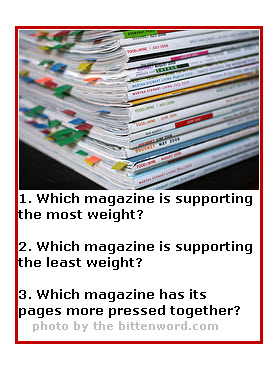
1. Use pillows of equal size and content. Fluff each pillow as much as possible, and then lay one pillow on a hard surface, such as a table. Use a yardstick (meter stick) to measure the height of the pillow.
2. Carefully place a second pillow on top of the first one. Measure the height of the two pillows.
3. Repeat step 2 with at least 2 more pillows, and then measure the height of the bottom pillow again. Compare this measurement with that taken in step one.
Results: The height of the bottom pillow should decrease.
 |
Earth Science |