VanCleave's Science Fun

Your Guide to Science Projects, Fun Experiments, and Science Research

ABOUT THE SOUND PICTURE

With mouth wide open, vibrating air coming up the throat from the vocal chords leaving the open mouth and spreading in all directions. Hi, I am Janice VanCleave, author of 50+ best-selling science experiment books for children ages 4 through high school. I taught science for 27 years and now am creating this science website.   My scream was not staged. The picture was to be of two adult cats, which I was holding. A microsecond before the camera snapped, the two cats dug their claws into my skin as they prepared to leap out of my arms. A picture like this is great for making inferences. Kids could make "guesses" as to why I am screaming. They would be drawing on facts from the photo, such as I look like I am in pain or maybe I am just pretending.

Sound Supplies and Sound Investigations

Educational Innovation Sound Supplies A black and yellow logo for Educational Innovations. A place to find fun science supplies.
  • Home
  • ASK JANICE
  • Teacher Guide
  • Homeschool Science For Kids
Home » Fluorescence

Fluorescence

By Janice VanCleave

Question: What causes some objects to glow under a black light?

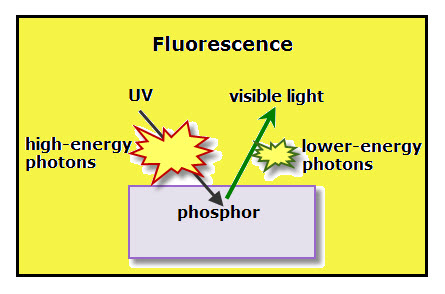
Black lights give off  Ultraviolet A light, which is a type of high-energy invisible light (radiation). Photons are packets of light energy. UV light photons have a higher energy than do the photons for visible light.

Materials that glow under a black light contain a type of chemical called a phosphor. When phosphors absorb UV photons,  some of the electrons in the atoms making up the phosphor  become energized or excited. This means that the electrons move further way from the nucleus.

FACT: The UV light energy is called the excitation energy because it causes the electrons to be excited.

When energized electrons release the absorbed excitation energy, they return to their normal position, called ground state. Photons of visible light make up part of the released energy. The color of light emitted depends on the  energy of the released photons.

The amount of time it takes excited electrons to lose the excitation energy depends on the type of phosphor being excited. Phosphors that only release glow while the excitation energy is being received are said to be fluorescent.

The glow from a phosphor after absorbing hight energy UV photons is an example of photoluminescence. WOW! That is a big word, but it is actually easy and certainly fun to experiment with. Let’s take the word apart:

photo is a prefix for light
luminescence is any cold light–light from something that is not hot, such as fireflies or glow sticks.

OK, if we put the word parts back together we have a cold light—photoluminescence.

For more fun with fluorescence, see Spy Pen With Invisible Ink. 
33101X: Sticky, Gloppy, Wacky, and Wonderful Experiments Sticky, Gloppy, Wacky, and Wonderful Experiments

Share this:

  • Email a link to a friend (Opens in new window) Email
  • Share on X (Opens in new window) X
  • Share on Facebook (Opens in new window) Facebook
  • Print (Opens in new window) Print

Filed Under: Physics Tagged With: EMR, fluorescence, luminescence, photoluminescence, photons, UV, visible light

Topic Search

Visitors From All Over the World


Welcome to Janice’s Science Extravaganza!

The spoon hanging from the string vibrates when struck and these vibrations are transmitted through the string and the sound is amplified by the plastic cups. ABOUT ME: Hi, I am Janice VanCleave, author of 50 best-selling science experiment books for children ages 4 through high school. I taught science for 27 years. MORE.....

Introductory CAT Lesson

Science CAT Activity and SCI/Art  

SOON! More CAT Activities

Janice VanCleave CAT Stickers

Order Your CAT Stickers Here

FAQs

Janice VanCleave answers your questions about all the different kinds of color changing products.

Check here for Frequently Asked Questions about CAT
stickers.

Send Questions to Janice

Send Information to me using this form.

Contact Janice

Other Janice VanCleave Free Color Changing Lessons

  • HAT Stickers Heat Activated Thermochromic Stickers Stickers that change colors when heated.
  • SA Stickers Sun Activated Stickers Stickers that change color when exposed to sunlight.
  • TLC Dot Stickers Thermochromic Liquid Crystal Stickers Stickers that, like Mood Rings, change color when heated.

Copyright © 2026 · Janice Van Cleave · JVC's Science Fair Projects · Log in