VanCleave's Science Fun

Your Guide to Science Projects, Fun Experiments, and Science Research

ABOUT THE SOUND PICTURE

With mouth wide open, vibrating air coming up the throat from the vocal chords leaving the open mouth and spreading in all directions. Hi, I am Janice VanCleave, author of 50+ best-selling science experiment books for children ages 4 through high school. I taught science for 27 years and now am creating this science website.   My scream was not staged. The picture was to be of two adult cats, which I was holding. A microsecond before the camera snapped, the two cats dug their claws into my skin as they prepared to leap out of my arms. A picture like this is great for making inferences. Kids could make "guesses" as to why I am screaming. They would be drawing on facts from the photo, such as I look like I am in pain or maybe I am just pretending.

Sound Supplies and Sound Investigations

Educational Innovation Sound Supplies A black and yellow logo for Educational Innovations. A place to find fun science supplies.
  • Home
  • ASK JANICE
  • Teacher Guide
  • Homeschool Science For Kids
Home » History Of Classification

History Of Classification

By Janice VanCleave

What is Taxonomy and Who Introduced It?
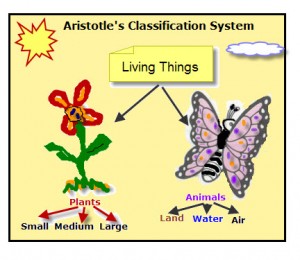
Aristotle's Classification System


Taxonomy is the science of how living things are grouped together. Another name often used for taxonomy is classification.

Scientists who study  taxonomy are called taxonomists. The Greek scientist, Aristotle (384-322 B.C.), was one of the first scientist to organize living things, thus among other things he studied, Aristotle was a taxonomist.

Aristotle developed the first classification system, which divided all known organisms into two groups:

PLANTS and ANIMALS

Aristotle then divided each of these main groups into three smaller groups.

Animal Subgroups: Land, Water, Air
Plant Subgroups: Small, Medium, Large

Aristotle’s classification system was not very good. There were too many organisms that didn’t fit. For example, frogs are born in water and have gills like fish, but when they grow up they have lungs and can live on land. So how would Aristotle classify frogs? In Aristotle’s classification system, birds, bats, and flying insects were grouped together even though they have little in common except they can fly. But the penguin is a bird that cannot fly. So Aristotle would not have classified them as birds.
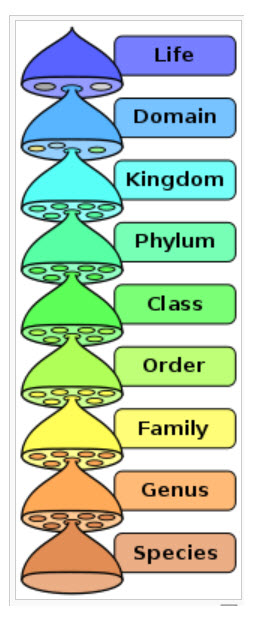
The classification hierarchy in order from largest to smallest, life, domain, kingdom, phylum, class, order, family genus, species.
Classification ranking from the largest to the least number of organisms.

Even with the many problems of Aristotle’s limited classification system, it was used for nearly 2000 years until it was replaced in the 1700s by the Swedish biologist, Carolus Linnaeus (1707-1778).

Linnaeus, like Aristotle, classified organisms according to their traits. The classification systems of both Aristotle and Linnaeus started with the same two groups: Plants and Animals. Linnaeus called these groups, kingdoms. But, unlike Aristotle, Linnaeus divided kingdom into five levels: class, order, genus, species, and variety. Organisms were placed in these levels based on traits, including similarities of body parts , physical form such as size, shape, and methods of getting food.

Linnaeus is known as the father of taxonomy. In addition to his expanding the classification system, he established a simple way of naming each species. This is called a binomial naming system and it has two parts. The first part of the species name identifies the genus to which the species belongs; the second part identifies the species within the genus.

For example, humans belong to the genus Homo and within this genus to the species sapiens, thus the two-part species name for humans is Homo sapiens. The genus name is capitalized and each name is written in italics.
This book has information and experiments about ecology.

Ecology For Every Kid
This book has information and experiments about ecology.

Ecology is the study of the behavior of living things in their natural surroundings and how they affect each other.

(Paid Link)

Share this:

  • Email a link to a friend (Opens in new window) Email
  • Share on X (Opens in new window) X
  • Share on Facebook (Opens in new window) Facebook
  • Print (Opens in new window) Print

Filed Under: Biology Tagged With: classification, Linnaeus, taxonomy

Topic Search

Visitors From All Over the World


Welcome to Janice’s Science Extravaganza!

The spoon hanging from the string vibrates when struck and these vibrations are transmitted through the string and the sound is amplified by the plastic cups. ABOUT ME: Hi, I am Janice VanCleave, author of 50 best-selling science experiment books for children ages 4 through high school. I taught science for 27 years. MORE.....

Introductory CAT Lesson

Science CAT Activity and SCI/Art  

SOON! More CAT Activities

Janice VanCleave CAT Stickers

Order Your CAT Stickers Here

FAQs

Janice VanCleave answers your questions about all the different kinds of color changing products.

Check here for Frequently Asked Questions about CAT
stickers.

Send Questions to Janice

Send Information to me using this form.

Contact Janice

Other Janice VanCleave Free Color Changing Lessons

  • HAT Stickers Heat Activated Thermochromic Stickers Stickers that change colors when heated.
  • SA Stickers Sun Activated Stickers Stickers that change color when exposed to sunlight.
  • TLC Dot Stickers Thermochromic Liquid Crystal Stickers Stickers that, like Mood Rings, change color when heated.

Copyright © 2026 · Janice Van Cleave · JVC's Science Fair Projects · Log in