

What Does Thermochromic Mean?
The word thermochromic can be broken into two parts:
thermo: This prefix refers to temperature. meaning temperature and “chromic” meaning color. Together, thermochromic indicates that the substance changes color when its temperature changes.
chromic: In chemistry, chromic refers to changes, often reversible, in the colors of chamicals.
Thus, thermochromic means color changes of chemicals in response to changes in temperature.
How Do Thermochromic Chemicals Change Colors?
The color of chemicals or anything you see is due to the visible light that the object reflects.  For example, the apple shown appears red because red visible light is reflected from the drawing to your eyes. The visible light spectrum is also called the rainbow colors. Using the first letter of the colors as they appear in the rainbow spells out a man’s name: ROY G. BIV (Red, Orange, Yellow, Green, Blue, Indigo, Violet)
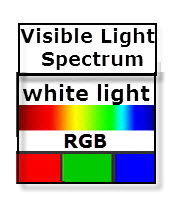
The diagram shows the visible light spectrum. Note that this spectrum is also called white light.
The color of anything you see is due to the visible light that is reflected by the object entering your eyes. For example, the apple is red because red visible light is reflected from the drawing to your eyes. The spectrum of colors in visible light are also called the rainbow colors. Using the first letter of the colors as they appear in the rainbow spells out a man’s name: ROY G. BIV (Red, Orange, Yellow, Green, Blue, Indigo, Violet)
When the entire visible light spectrum reflects from an object, the object appears to be white. Thus, light made up of the visible light spectrum is said to be “white light.”
RGB is used to indicate the entire light spectrum, from red through green and past blue.
Difference between Dyes and Paints
Dyes and paints are different. A dye bonds to a surface, which means it links to the surface. A paint covers the surface. This is why paints will peel off a surface and dyes as a rule do not.
Generally a dye has a specific color. But Leuco dyes (LDs) will change with a flucuation of temperature. Thus LDs are thermochromic. There are two types of Leuco dyes:
Types of Thermochromic Leuco Dyes
1. Cold Activated Thermochromic LDs also called CAT LDs. At room temperature, CAT Leuco dyes are transparent, meaning light passes through them much like light passes through a glass window. You can see through a glass window because light reflecting from objects passes through the window to your eyes.
When cooled, CAT LDs have a color. The temperature at which the dyes are colored is called the activation temperature.
When CAT LDs are cooled, the Leuco dye molecules change shape. This new molecular shape is no longer transparent to the visible light spectrum. Instead, when light strikes the dye molecules, some parts of the visible light spectrum is absorbed by the molecules and some of the visible light spectrum is reflected away from the molecules. The color of the cooled dye is the visible light its molecules reflect to your eyes.
CAT LDs are reversible. This means that they continue to change from being transparent to colored and back to transparent again and again when cooled then warmed and so on.
ThermoSmart CAT LDs make color changes for twelve or more months unless heated to extreme temperatures or exposed for extended periods to Ultraviolet Light (sunlight or other UV sources).
2. Heat Activated Thermochromic LDs also called HAT LDs. At room temperature HAT Leuco dyes have a color. As with any colored material, the color is due to the visible light color the dye molecules reflect. Yes, the remaining color spectrum of visible light is absorbed by the dye molecules.
When heated, the HAT leuco dye molecules change to a shape that is transparent to the visible light spectrum.
When HAT LDs are heated above room temperature, the Leuco dye molecules change shape. This new molecular shape no longer reflects visible light. Instead, when light strikes the dye molecules it passes through.
Yes, HAT Leuco dyes like CAT LDs are reversible. These dyes change from colored to transparent and back to colored again and again when heated and then cooled and so on as long as you continue to change the temperture of the dye.